Xylazine is an animal sedative that has been turning up more frequently in illicit drug supplies across the country. It is often added to drugs without the user realizing its presence. This guide explains its risks, signs, and treatment options, and BlueCrest’s approach to drug addiction treatment.
Key Takeaways
- Xylazine is an animal tranquilizer that is not for human use. However, it is often mixed with fentanyl or other opioids and sold on the street.
- The drug can cause sedation, slowed heart rate and breathing, and skin wounds, and stopping can lead to withdrawal symptoms. It is difficult to determine which symptoms are caused by Xylazine and which are attributed to opioids, although skin ulcers are a distinctive sign of Xylazine use.
- Naloxone should be used if an overdose is suspected, as it will reduce risks related to opioids. However, you should also call 911 and administer rescue breaths, as Xylazine may still present unique risks in the body.
Table of Contents
- How Did Xylazine End Up In the Drug Supply?
- How Common Is Xylazine?
- Is Xylazine Illegal?
- What Does Xylazine Do To the Body?
- What Is the Overdose Risk Associated with Xylazine?
- What Should I Know About Xylazine Withdrawal?
- What Are Signs Loved One May Be Using Xylazine?
- What Are Xylazine Treatment Options?
- How Can Families Help?
- Get the Help You Need at BlueCrest Recovery
- FAQs
Introduction
Xylazine, AKA ‘tranq,’ is a tranquilizer, pain reliever, and central nervous system depressant approved for animal use only. In veterinary medicine, it is typically used for large animals such as horses. It works as an alpha-2 adrenergic agonist, meaning it slows down the brain and body.

The drug has made its way into the U.S. drug supply, often added to illicit substances. Although it is not an opioid, it is often combined with opioids, such as fentanyl, and sold as ‘tranq dope’.
How Did Xylazine End Up In the Drug Supply?
Xylazine emerged as an additive in Puerto Rico’s drug supply in 2001, likely diverted from veterinary sources. By the mid-2010s, it was spreading through U.S. drug markets alongside illicitly made fentanyl, starting in the Northeast and later reaching the Rust Belt, South, and West.
While commonly mixed with opioids, it can also be mixed with other drugs to increase their weight and street value. It is cheap and easy to mix. While typically injected, it can also be sniffed or swallowed.
How Common Is Xylazine?
Federal and state data show this veterinary tranquilizer has become a common presence in the illicit drug supply.
- Drug Enforcement Administration (DEA) lab analyses found xylazine in over 25% of fentanyl powder samples and over 8% of pill samples in 2025.
- According to the DEA, xylazine was involved in 6,096 drug poisoning deaths in 2023, making it the fourth most common substance in those deaths.
- In the local drug supply of New Jersey, one-third of suspected heroin and fentanyl seizures contained xylazine in 2022, rising to 45% in the first quarter of 2023. About 99% of seizures containing xylazine also contained fentanyl.
- In 2021, nearly 8% of New Jersey overdose deaths involved xylazine, and that rose to 10% in the first half of 2022.
Is Xylazine Illegal?
Xylazine is not currently a federally controlled substance, though it isn’t approved for human use. Federal lawmakers are working to change that.
The Combating Illicit Xylazine Act, a national drug control policy, would list xylazine as a Schedule III controlled substance while protecting legal use by veterinarians, farmers, and ranchers. It passed the House unanimously and now heads to the Senate.
What Does Xylazine Do To the Body?
Xylazine causes various symptoms such as:
- Sedation
- Low blood pressure
- Slowed heart rate
- Skin wounds that can become infected
- Confusion
- Loss of coordination
- Low body temperature
Its effects are similar to opioids, making it difficult to determine which drug is responsible.
Xylazine-associated wounds are one of the most telltale signs. These skin ulcers can develop with repeated exposure, are distinct from the abscesses and cellulitis more typical of injection drug use, and can appear away from the injection site. Without proper wound care, they can lead to amputation and may be life-threatening.
Harm reduction strategies include cleaning wounds with soap and water, and using antibiotics when necessary. Drug users should also monitor for complications, such as fever, increasing size, and changing colors.
What Is the Overdose Risk Associated with Xylazine?
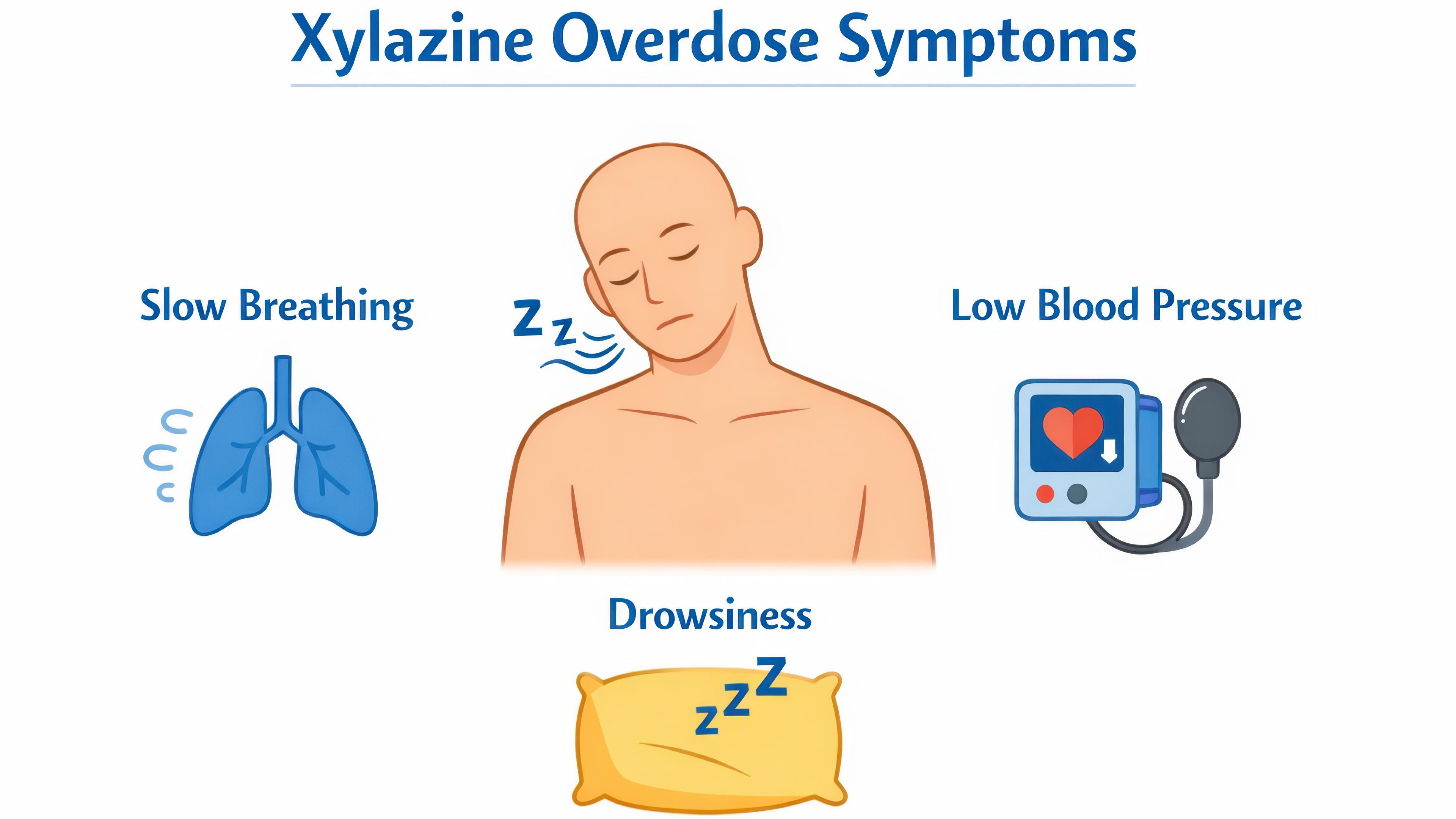
While it is unclear how much xylazine adds to the risk of overdose, it causes slowed breathing, heart rate, and brain function, which should be treated as a medical emergency.
Naloxone (Narcan) cannot reverse the effects of Xylazine, but it should be given, as it is often mixed with opioids and can reverse an opioid overdose. Additionally, if you see someone possibly experiencing an overdose involving Xylazine, contact 911, as the drug’s effects can continue after Naloxone is administered. Rescue breaths are especially helpful, since xylazine slows breathing.
What Should I Know About Xylazine Withdrawal?
Xylazine is physically and psychologically addictive and can cause withdrawal symptoms such as agitation and anxiety. Symptoms include persistent high blood pressure, restlessness, and agitation, which differentiate it from opioid withdrawal. However, because opioid and xylazine addiction often co-occur, symptoms commonly overlap.
Research on treating xylazine withdrawal is limited, and there is no standardized treatment. Clinicians have used addiction medicines like clonidine and gabapentin in published cases. In any case, a supervised approach is always recommended for comfort and safety.
What Are Signs Loved One May Be Using Xylazine?
Various physical signs and behavioral changes may indicate a loved one is using xylazine, as follows:
- Physical signs: Wounds or sores that don’t heal, especially in unusual places, and extreme drowsiness or “nodding off”
- Coordination and thinking: Confusion, slurred speech, or unsteadiness
- Behavioral changes: Withdrawing from family, secrecy, changes in sleep, or missing responsibilities
What Are Xylazine Treatment Options?
Xylazine treatment typically includes medical detox and medications followed by rehab therapy and support.
- Medical Detox: Often the first stage of addiction treatment, it focuses on managing withdrawal symptoms related to drug and alcohol dependence. Medications may reduce the risk of complications.
- Rehab: Once clients have stabilized, they move on to rehab, addressing the underlying cause of drug addiction. Care typically spans multiple levels. For example, BlueCrest Recovery offers various levels of outpatient care, including partial care, an intensive outpatient program, and traditional outpatient services.
- Aftercare: Provides ongoing support as clients reintegrate into society.
How Can Families Help?
Families can help by talking with loved ones about getting help, keeping naloxone on hand, and knowing what to do in an emergency.
- Start the Conversation Calmly: Approach your loved one in a soothing environment, not in the middle of a crisis. Adopt a nonjudgmental,non-shaming tone.
- Keep Naloxone on Hand: Naloxone is available for free at many participating pharmacies, or call the New Jersey Harm Reduction Coalition to have a kit mailed to you anonymously.
- Know How to Respond to an Overdose: Give naloxone, call 911, and provide rescue breaths. Good Samaritan laws in most states protect people who seek help for an overdose.
Get the Help You Need at BlueCrest Recovery
It’s understandable to feel worried after reading about xylazine, but people do recover, and families can help with that journey. If someone you love is using tranq or any other substance, BlueCrest Recovery Center in Woodland Park, New Jersey, can help you find the right next step. Contact our admissions team to talk through your options.
FAQs
What is xylazine (tranq)?
Xylazine is a sedative and pain reliever approved only for veterinary use, usually on large animals like horses. It isn’t approved for humans, but it’s increasingly found in the illegal drug supply.
Is xylazine an opioid?
No. Xylazine is a non-opioid sedative, but it’s often mixed with opioids like fentanyl, which is why the two are so closely linked.
Why is xylazine mixed with fentanyl and other drugs?
Xylazine is often mixed with fentanyl and other drugs because it can boost their effects and add weight, which raises their street value. It’s also cheap and easy to obtain, so many people don’t know it’s in what they’re using.
Does Narcan (naloxone) work on xylazine?
Naloxone doesn’t reverse xylazine’s effects, but it should still be given in any suspected overdose because xylazine is usually mixed with opioids. Always call 911 as well, since xylazine’s sedation can continue after naloxone is given.
What are xylazine wounds?
Xylazine wounds are severe skin ulcers that can develop with repeated xylazine exposure. They can appear away from the injection site and may become infected, so they need prompt medical care.
Sources
- National Institute on Drug Abuse. “Xylazine.” https://nida.nih.gov/research-topics/xylazine
- Centers for Disease Control and Prevention. “Xylazine.” https://www.cdc.gov/overdose-prevention/about/what-you-should-know-about-xylazine.html
- U.S. Food and Drug Administration. “FDA alerts health care professionals of risks to patients exposed to xylazine in illicit drugs.” https://www.fda.gov/drugs/drug-safety-and-availability/fda-alerts-health-care-professionals-risks-patients-exposed-xylazine-illicit-drugs
- PubMed, National Library of Medicine. “Public health impact and harm reduction implications of xylazine-involved overdoses: a narrative review.” https://pubmed.ncbi.nlm.nih.gov/37700329/
- Drug Enforcement Administration (via U.S. Senate Committee on the Judiciary). “Letter of Support for S. 545, Combating Illicit Xylazine Act.” https://www.grassley.senate.gov/download/drug-enforcement-administration_-letter-of-support?download=1
- Morbidity and Mortality Weekly Report, CDC. “Illicitly Manufactured Fentanyl–Involved Overdose Deaths with Detected Xylazine — United States, January 2019–June 2022.” https://doi.org/10.15585/mmwr.mm7226a4
- New Jersey Department of Health. “Health Alert: Xylazine in the New Jersey Illicit Drug Supply.” https://www.nj.gov/health/populationhealth/documents/XylazineintheNewJerseyIllicitDrugSupply.pdf
- Office of Rep. Deborah Ross. “Rep. Ross’ Combating Illicit Xylazine Act Passes House Unanimously.” https://ross.house.gov/2026/9/rep-ross-combating-illicit-xylazine-act-passes-house-unanimously
- Congress.gov, Library of Congress. “S.545 – Combating Illicit Xylazine Act.” https://www.congress.gov/bill/119th-congress/senate-bill/545
- PubMed Central, National Library of Medicine. “Xylazine Withdrawal: A Case Report From the Intensive Care Unit to the Medical Ward.” https://pmc.ncbi.nlm.nih.gov/articles/PMC12331367/
- PubMed, National Library of Medicine. “Management of xylazine toxicity, overdose, dependence, and withdrawal: A systematic review.” https://pubmed.ncbi.nlm.nih.gov/40476542/
- Morbidity and Mortality Weekly Report, CDC. “Reported Xylazine Use Among Adults Aged ≥18 Years Evaluated for Substance Use Treatment — United States, July 2022–September 2023.” https://www.cdc.gov/mmwr/volumes/73/wr/mm7326a2.htm
- ScienceDirect. “Xylazine, a Nonopioid Sedative and Public Health Crisis—An Overview.” https://www.sciencedirect.com/science/article/pii/S1555415525002715